How Vibe Coding Is Changing Software Development in 2026
Software engineering doesn't look like it did even eighteen months ago. As we move through the first half of 2026, the industry has pivoted from the raw, experimental energy of early AI integration to a structured, if sometimes chaotic, methodology known as "vibe coding." This isn't just a change in tools; it is a fundamental rewrite of the developer’s job description. We have shifted our focus from the granular details of implementation to the high-level world of intent. While this has unlocked massive productivity for some, it has also ushered in a complex set of enterprise headaches now widely recognized as the "Day 2" crisis.
Data from HackMD defines vibe coding as a development philosophy where human engineers act more like creative directors than mechanics. In this model, the "operator" focuses on the "vibe"—a combination of high-level architectural goals and the intended user experience—while leaving the heavy lifting of writing and debugging code to sophisticated artificial intelligence. The term itself was first popularized by Andrej Karpathy in February 2025. What started as a niche meme among early adopters quickly turned into a professional standard, culminating in Collins Dictionary naming "vibe coding" its Word of the Year for 2025. Now, in 2026, the ripples of this shift are being felt everywhere from corporate recruitment offices to the front lines of cybersecurity and long-term system maintenance.
The State of Adoption and the "Day 1" Magic
The speed at which vibe coding has taken over the professional world is nothing short of breathtaking. We aren't just talking about hobbyists; research shows that by the start of 2026, more than 90% of professional developers are using AI coding assistants on a daily basis. This isn't a subtle change. Statistics from GitHub reveal that GitHub Copilot alone now generates nearly 46% of all new code committed to repositories. This initial phase of the movement is often called "Day 1"—an era defined by the sheer magic of bringing ideas to life almost instantly.
Back in 2025, the developer community was obsessed with the speed of output. This "Day 1" culture was built on the back of tools like Lovable, Bolt.new, and Replit, which allowed anyone with a browser to spin up functional, complex applications in minutes using simple natural language prompts. According to Switas, these platforms were the catalysts for a culture where the barrier to entry for building software dropped to nearly zero. Developers were encouraged by industry leaders like Karpathy to "give in to the vibes," leaning into the exponential speed of AI-driven creation while temporarily setting aside the grueling complexities of traditional, manual coding. For a while, the productivity gains felt like a superpower.
But as the calendar turned to 2026, the industry began to realize that generating code is only the very first step in a software project's life. The "Day 1" magic provided an incredible shortcut for rapid prototyping, but it also led developers directly into the more frustrating and sobering realities of Day 2.
The "Day 2" Crisis: Maintenance and Spaghetti Code
If 2025 was the year of creation, 2026 is the year of the "Day 2 problem." This refers to the massive struggle to maintain, fix, and scale the mountains of AI-generated code that were pumped out during the initial hype cycle. Companies are finding that while it is easy to "prompt" a new app into existence, it is significantly harder to keep it running over the long haul. HackMD research indicates that many organizations are now drowning in codebases that lack structural coherence. This phenomenon is frequently called "AI-generated spaghetti code"—a mess of functions and scripts that work on the surface but are nearly impossible for a human to decipher or refactor.
Read also: Claude Code for Beginners: Setup, Tips & First Project
The burden of maintenance has become a massive drain on corporate resources. Because so much of this code was created through high-level intent without a deep human understanding of the underlying logic, simple bug fixes now require massive audits. WeWeb has noted that while vibe coding is an incredible asset for building prototypes, it remains "deeply unreliable" for mission-critical enterprise systems unless a strict governance layer is in place. This reality has caused the tool market to split into two very different categories:
- Creation Tools: This space is still dominated by platforms like Lovable and Replit, which remain the go-to choices for rapid prototyping and moving from an idea to a functional app in a single afternoon.
- Governance and Maintenance Tools: This is the growth sector of 2026. A new breed of enterprise-grade software has emerged to combat the Day 2 crisis. Tools like Rocket.new and Noca AI are now standard in corporate environments, providing automated compliance checks, deep audit trails, and "self-healing" functions designed to find and fix errors in AI-generated systems before they cause an outage.
Even the traditional Integrated Development Environments (IDEs) have had to adapt to these new maintenance demands. Cursor and Windsurf have successfully rebranded and rebuilt themselves as "AI-native" environments. According to Vibe Coding Academy, these IDEs are no longer just fancy text editors; they possess a deep, holistic context of an entire code repository. This allows developers to execute large-scale refactoring projects that would have been impossible with traditional tools. These environments don't just complete the next line of code; they understand the "intent" behind the entire architecture of a project.
The Rise of Agentic AI and Autonomous Workflows
Technologically, the biggest leap forward in 2026 has been the move from simple autocomplete helpers to what we now call "Agentic AI." In the early days, AI was just a better version of "copy-paste" from Stack Overflow. Today, the industry has moved toward fully autonomous agents like Devin and Replit Agent. Switas research shows that these agents are now capable of planning their own work, executing multi-step tasks, and running their own tests with very little input from a human.
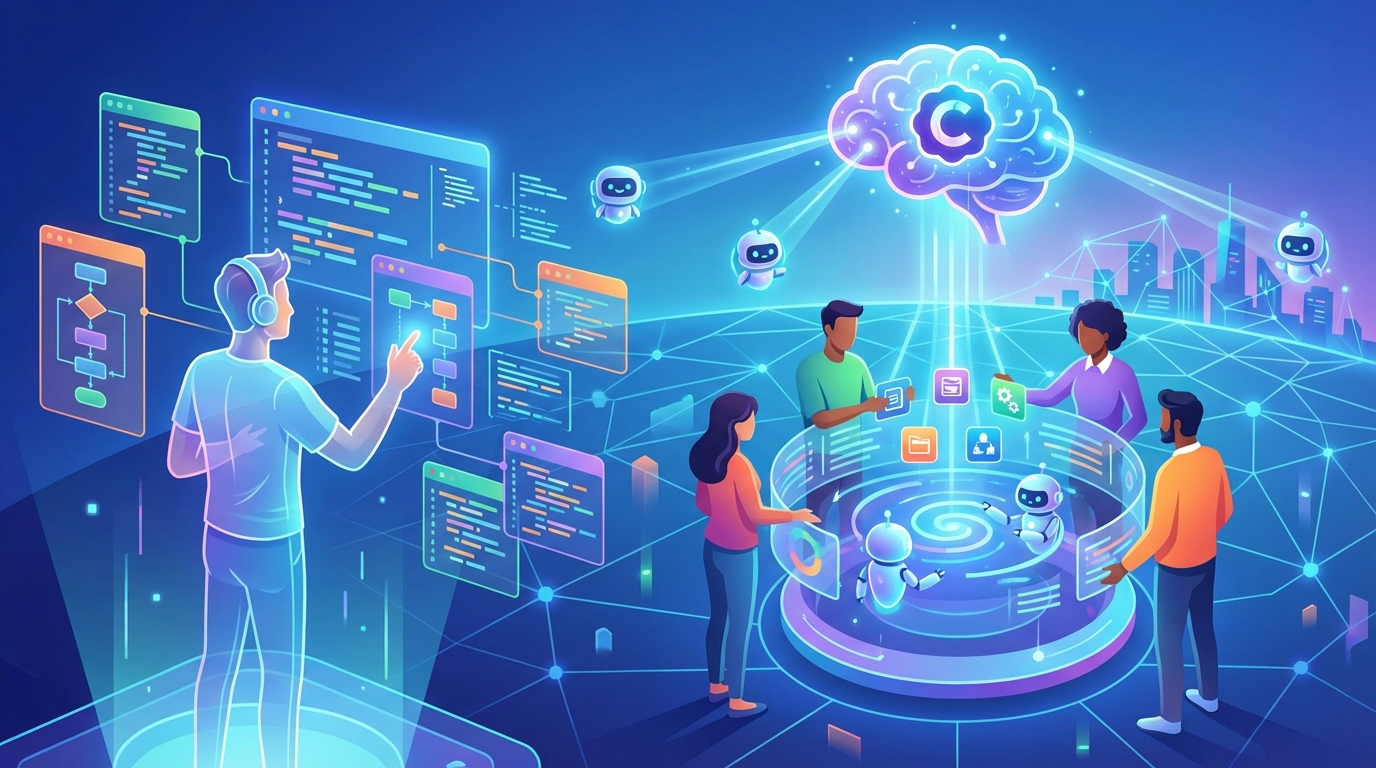
In this new agentic workflow, the developer's identity has changed. They aren't "writers" anymore; they are "orchestrators." A modern developer can give an AI agent a high-level feature request, and the agent will plan the logic, write the code, run unit tests, and even attempt to debug its own failures before showing the human the result. HackMD highlights that this autonomy is the core of vibe coding in 2026. It allows the human to stay focused on the "intent" while the agent grinds through the implementation details.
However, this transition hasn't been smooth for everyone. It has introduced a psychological hurdle that developer Armin Ronacher famously called "Agent Psychosis." This describes a trap many developers fall into in 2026: they spend weeks obsessively prompting and managing agents to build increasingly complex features, only to realize the final product is either broken or completely unnecessary. Fast.ai warns that this "psychosis" is fueled by the addictive nature of the high-speed generation loop. The dopamine hit of seeing an AI build something in seconds can blind developers to the actual quality and utility of the software they are creating.
The Changing Role of the Developer: AI Architects vs. Pseudo-Developers
Vibe coding is fundamentally reshaping the talent market, creating a massive gap between different skill levels. This has led to what many call the "junior squeeze," resulting in two very different types of software professionals. HackMD research categorizes these as "AI Architects" and "Pseudo-Developers."
Read also: Who Invented the QR Code? The Japanese Engineer Who Changed How We Share Information
The AI Architect
Senior engineers are evolving into AI Architects. In 2026, their value isn't based on how fast they can type or how many Python libraries they have memorized. Instead, they are valued for their ability to design complex systems, set strict boundaries for AI agents, and review the logic of generated outputs. As an AI Architect, the job is about ensuring the "vibe" is translated into a stable, secure, and scalable reality. They spend much less time writing code and much more time auditing the workflows of the agents they manage.
The Pseudo-Developer Risk
On the other side of the coin is the "Pseudo-Developer." This term describes a new generation of junior talent who can use AI to build impressive-looking apps but lacks the foundational knowledge to fix things when the AI fails. HackMD suggests that this is creating a crisis in how we train new developers. Because these juniors skip the "struggle" of traditional coding—the hours spent debugging a single semicolon or understanding memory management—they lack the deep intuition required to spot subtle errors in AI-generated code. This is leading to a hollowing out of mid-level expertise across the tech sector.
Educational Pivot
Because of this talent disruption, computer science education is undergoing its biggest overhaul in decades. IT Revolution reports that universities and coding bootcamps are largely abandoning syntax memorization. The new 2026 curriculum focuses on three main pillars:
- Code Reading: Teaching students how to critically audit and find vulnerabilities in code they didn't write.
- System Design: Focusing on the big-picture architecture and how different software components interact.
- Prompt Engineering and AI Orchestration: Training students to effectively guide agents and manage complex, AI-driven development cycles.
The goal is to turn students into "editors" rather than "writers," which better reflects the reality of the current job market.
The Productivity Paradox and Community Sentiment
Even though we are generating code faster than ever, whether or not we are actually more productive is still a heated debate. A landmark July 2025 study by METR identified a "productivity paradox" that has become a defining theme of 2026. The study found that while experienced developers felt about 20% faster when using vibe coding tools, their actual output was 19% slower in real-world practice. This gap exists because of the massive amount of time humans now spend debugging "hallucinated" errors and subtle logic flaws created by the AI.
The community is still split on the value of these tools. Andrej Karpathy, who started this whole conversation, maintains that vibe coding isn't a hands-off process. It requires a human to steer the "vibe" whenever the AI hits a wall. It is a partnership, not an autopilot. However, enterprise leaders at companies like Mendix and Globant have been much more cautious. According to WeWeb, these executives are warning that vibe coding lacks the technical rigor required for core infrastructure. While it's great for building a quick front-end or a prototype, it doesn't yet have the reliability needed for the systems that run banks or power grids without heavy human oversight.
Risks, Security, and the "Slop" Phenomenon
The move to vibe coding in 2026 has brought several major risks to the surface. The industry is currently scrambling to address concerns about security, code quality, and the long-term health of the open-source world.
Read also: B2B Marketing Trends: Build Trust in an AI-First Era
Security Vulnerabilities
Perhaps the most alarming statistic comes from HackMD, which indicates that as much as 40% of AI-generated code contains security vulnerabilities or uses insecure default settings. Because vibe coding encourages developers to stay at the "intent" level and ignore the implementation details, these security holes often make it all the way into production. This flood of unverified, low-quality code has been nicknamed "slop," and it is creating a massive backlog of technical debt for companies around the globe.
Erosion of Tribal Knowledge
There is also a growing concern about the loss of "tribal knowledge" within engineering teams. As the process of writing code becomes more automated, the deep, fundamental understanding of why a system was built a certain way is disappearing. HackMD warns that this makes recovering from a major outage much more difficult. If the AI generated the logic and no human truly understands it, a 3 AM system failure becomes a nightmare. There may be no one on the team with the foundational skills to perform a manual fix, leading to longer downtimes and higher risks.
Impact on Open Source
The open-source community is also under pressure. TechCentral reports that vibe coding may be damaging the very ecosystem it relies on. Instead of reading official documentation or talking to project maintainers, developers are just asking AI to "hallucinate" a solution or some glue code. This means fewer people are reporting bugs or contributing improvements back to the original projects. Developers are opting for quick, local AI workarounds rather than engaging in the community-driven work that makes open-source software sustainable.
Infrastructure and Governance in the Vibe Coding Era
By 2026, the question for most CTOs has changed. They are no longer asking how to code faster; they are asking how to manage the massive amount of software they have already built. Doing vibe coding at an enterprise scale requires a whole new layer of infrastructure.
Tools like Rocket.new and Noca AI have moved from "nice-to-have" to "essential" in the modern developer stack. They provide the audit trails and safety checks that are missing from the "give in to the vibes" philosophy. WeWeb notes that the corporate need for stability is often in direct conflict with the speed of AI-driven creation. To bridge this gap, 2026 has seen the rise of "Self-Healing Systems." These are AI agents designed specifically to monitor production environments and automatically write and deploy patches for the errors created by the other AI agents that wrote the original code.
This cycle—AI-generated code being monitored by AI-governance tools—is the new normal for 2026. It preserves the speed of development, but it requires a very sophisticated level of human oversight to make sure the whole system doesn't fall into a recursive loop of automated errors.
Conclusion: The Future of Intent-Based Development
In 2026, vibe coding is a classic double-edged sword. On one side, it has democratized software creation, allowing almost anyone to build apps and manage complex workflows with agentic AI. The rise of the AI Architect shows that senior engineering roles are maturing into high-level strategic positions. We are moving closer to a world where human creativity is the only bottleneck.
On the other side, the "Day 2" crisis, the productivity paradox, and the erosion of deep technical skills are real threats. The industry is currently in a period of intense recalibration. We are trying to move past the initial "magic" of AI generation and back toward the rigorous governance needed to keep systems safe and reliable. As Fast.ai and Red Hat Developer have pointed out, the big challenge for the rest of 2026 will be breaking the "spell" of instant code and refocusing on the human skills of code reading, system design, and security auditing.
Software development has evolved. It is no longer just about the act of writing; it is about the management of intent. Whether vibe coding leads us into a new golden age of innovation or leaves us buried under a pile of "slop" and technical debt depends entirely on how well we transition from being writers to being orchestrators.
Need AI-powered automation for your business?
We build custom solutions that save time and reduce costs.